Choose a lane before you chase everything.
A satisfying collection has a boundary. The boundary keeps buying, swapping and research focused. Pick one that matches the way your attention works.
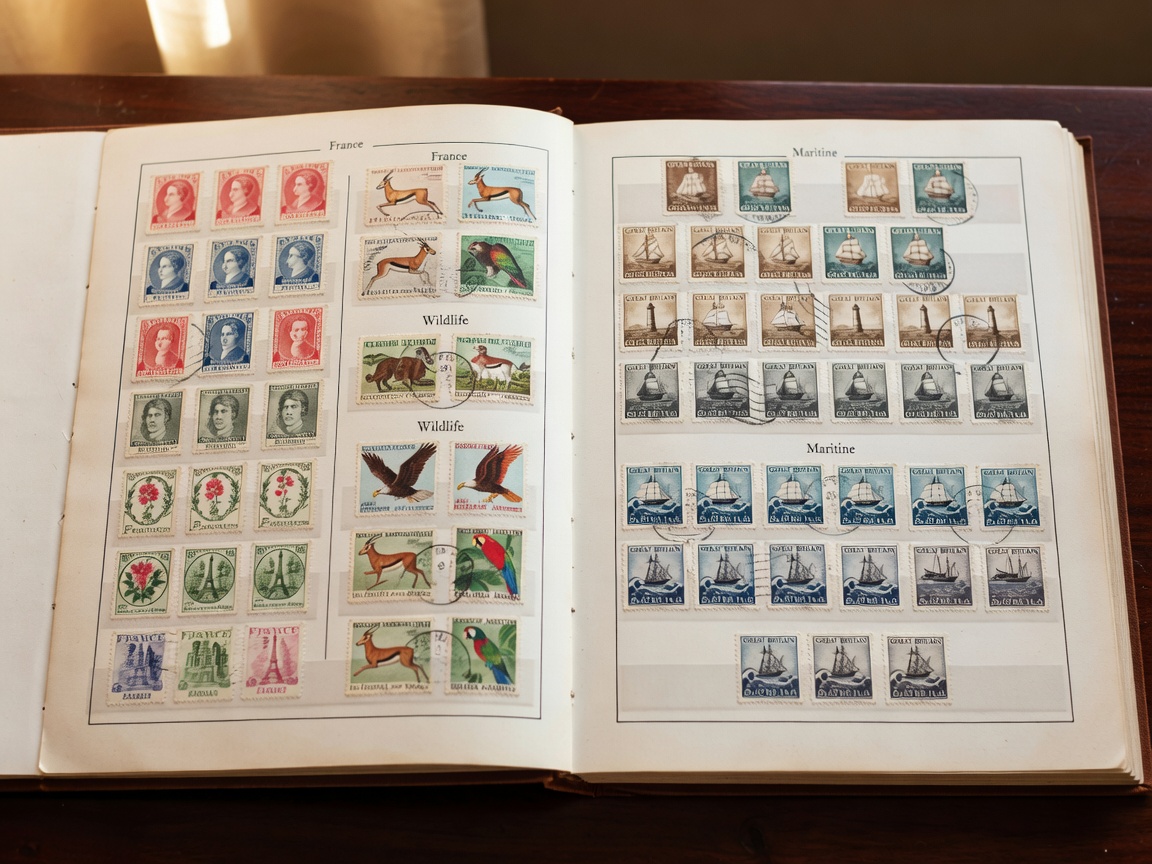
Understand the main collecting approaches
A country collection follows stamps issued by one country or postal authority. It suits collectors who enjoy chronology, design change and political geography. A thematic collection follows a subject shown on stamps, such as railways, flowers, literature, architecture or ships. It suits collectors who want visual variety across many issuing places. An era collection focuses on a broad historical period. It can be useful where paper, printing and postal rates changed in ways you want to compare.
A cancellation collection is built around postmarks. A cancellation is the mark used to show that a stamp has served its postal purpose. These collections reward close looking because the stamp design may be secondary to the place, date style or cancellation type. Postal history goes wider. It treats the whole item, often an envelope or card, as evidence of how mail moved. In postal history, the stamp is part of the story rather than the whole object.
Test your choice before buying heavily
- Write one sentence that says what belongs in the collection.
- Write one sentence that says what does not belong, even if it is attractive.
- Sort your existing stamps using those sentences.
- Set aside the stamps that almost fit and ask whether the boundary is too tight or too loose.
- Keep the boundary that creates enough material to work with but not so much that every stamp qualifies.
This test saves effort. If every packet adds hundreds of eligible stamps, the scope may be too broad. If nothing qualifies, the scope may be too narrow for casual collecting. Neither result is wrong, but each demands a different level of patience, reference work and storage.
Compare the trade-offs
| Approach | Strength | Trade-off |
|---|---|---|
| Country | Clear structure and catalogue support. | Common stamps may crowd the early pages unless you set limits. |
| Theme | Strong visual motivation and broad choice. | Definitions can blur unless you decide what the subject means. |
| Era | Good for comparing design and printing change. | Research may be needed before the shape becomes obvious. |
| Cancellation | Turns ordinary stamps into useful evidence. | Legibility matters, so many attractive stamps may not qualify. |
| Postal history | Keeps route, rate and handling context intact. | Storage needs more space than single stamps. |
Use catalogues without letting them run the hobby
A catalogue is a reference that lists stamps and helps identify varieties. In Britain, collectors often encounter Stanley Gibbons catalogues; internationally, other catalogue traditions exist. A catalogue can confirm names, issue groupings and design differences, but it should not decide whether you are allowed to enjoy a stamp. Use it to answer questions, then return to the album.
Catalogue values require caution. Treat them as reference signals, not promises. Condition, demand, selling route and completeness affect what a stamp might achieve in a transaction. For a motivational collection, the better question is whether the stamp strengthens the page, fills a useful space or teaches you something about the chosen scope.
Keep a side pocket for temptation
Temptation is part of collecting. A stamp outside your focus may be too good, too odd or too beautiful to ignore. Do not let it wreck the plan. Create a side pocket labelled “possible future collection”. This gives the stamp a safe home without forcing it into the main story.
Move now
Pick one boundary and use it for a full sorting session. If it makes decisions easier, keep it. If it creates arguments with every stamp, rewrite it in plainer words.